The phrase can describe a brand-like name used by betting-ID sellers, an exchange-style wagering interface, or—outside betting—an actual marketplace for gemstones. Search context matters. For India-focused queries involving login, ID, cricket or app, the intent is usually online wagering.
18+ · Financial loss and addiction are possible · This site does not take bets or issue accounts.
01
Three layers that search results often blur
Label
A public-facing name such as Diamond Exchange or DiamondExch.
Access provider
A person or site offering an ID, often through messaging apps.
Underlying operator
The entity that would hold terms, data, balances and dispute responsibility.
Those layers may not be the same organisation. Before relying on any claim, find the operator’s legal identity in its own terms and corroborate it through an authoritative register or regulator.
02
Exchange model versus bookmaker model
Question
Exchange-style market
Traditional bookmaker
Who sets available prices?
Participants may offer or accept positions, subject to the platform design.
The bookmaker generally posts the prices.
What does “back” mean?
A position in favour of an outcome.
Usually expressed as a standard bet on an outcome.
What does “lay” mean?
A position against an outcome, with liability that can exceed the stake.
Often not available in the same form.
What should be checked?
Liquidity, commission, settlement rules and counterparty model.
Margin, rules, limits and settlement terms.
This is general terminology, not evidence that any Diamond-named site actually operates a peer-to-peer exchange.
03
Claims that need evidence
“Official” needs a traceable legal operator and authoritative confirmation.
“Licensed” needs a regulator, licence number, scope and current status.
“Secure” needs more than HTTPS; look for governance, privacy, account controls and incident handling.
“Instant withdrawal” needs published terms and reliable, independent evidence.
“Available in India” does not mean lawful in India.
04
What a search result cannot establish
Rank position, a polished title and repeated brand wording are publishing signals, not identity evidence. Search engines can surface resellers, affiliates, old domains and user-submitted app listings beside one another. Even two pages that use the same colours or interface screenshots may be unrelated.
A reliable identity trail should connect the exact domain to a named operator, current terms, an accountable privacy contact and any claimed authorisation. If one link in that chain is missing, describe the service as unverified rather than filling the gap with assumptions.
Common questions
Questions readers ask
Is Diamond Exchange one company?
The name alone does not establish that. Current search results contain multiple unrelated domains and apps using similar wording.
Does HTTPS prove a site is legitimate?
No. HTTPS protects data in transit to that domain; it does not verify the operator, licence, legality or payout behaviour.
What is a lay position?
In exchange terminology, a lay position is against an outcome. Its potential liability may be larger than the amount displayed as the stake.
A safer next step
Check the entity, route and law before sharing anything.
A complete working method for Diamond Exchange what is diamond exchange — search and identity orientation
Direct answer: The useful way to approach this topic is to slow the sequence down: establish the exact task, verify legal entity, domain ownership, terms, app publisher, support route and payment recipient, calculate what could be exposed, and decide a stop rule before responding to a search result, forwarded link or advert using the Diamond Exchange name. Identify each layer independently before attributing any claim to one operator. This page is information; it does not create accounts, authenticate users, receive funds or confirm an operator.
The goal is a documented, low-exposure decision about Diamond Exchange what is diamond exchange — search and identity orientation. That requires more than recognising the Diamond Exchange name. It requires a chain of evidence in which each important claim has an accountable source, each request has a clear purpose, and every personal limit remains effective even when a page or person creates urgency. When an answer cannot be verified, “not established” is more accurate than either trust or accusation.
Use the sections below as a worksheet for Diamond Exchange what is diamond exchange — search and identity orientation. They organise terminology, actions, decision signals, mistakes and realistic situations around one practical rule: Identify each layer independently before attributing any claim to one operator. They do not promise availability, legality, safety, winnings, withdrawals or operator conduct; such claims require current evidence independent of a search result, forwarded link or advert using the Diamond Exchange name.
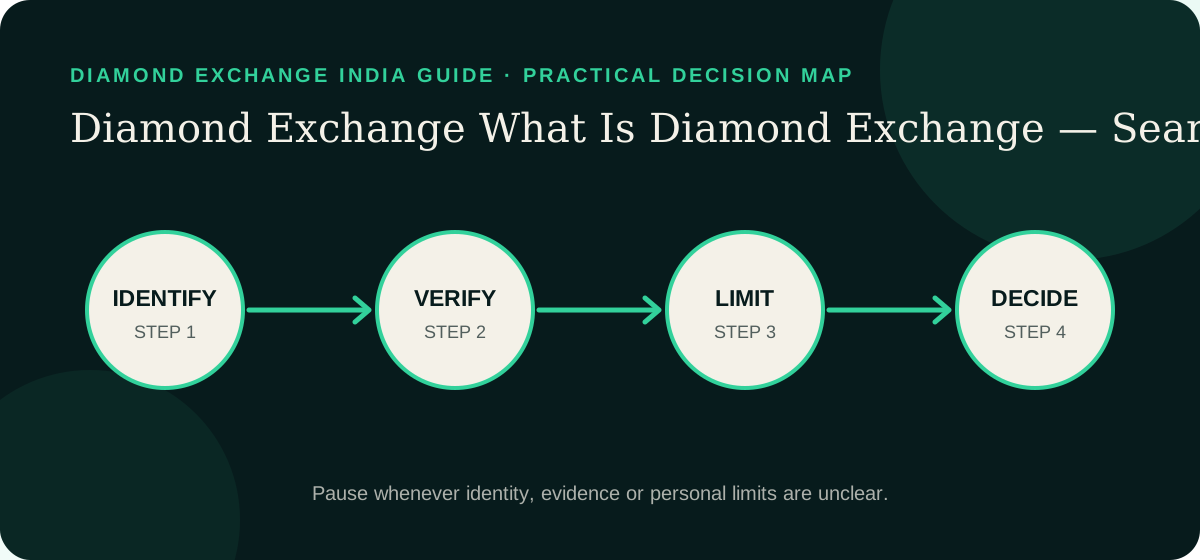
Diamond Exchange India Guide decision map: move from evidence to limits and stop whenever a material check remains unresolved.
Terminology
Words that matter when assessing Diamond Exchange what is diamond exchange — search and identity orientation
In a Diamond Exchange what is diamond exchange — search and identity orientation decision, familiar terms may carry a precise security, legal or financial meaning. These conservative definitions help a reader evaluate legal entity, domain ownership, terms, app publisher, support route and payment recipient without allowing a promotional phrase or a search result, forwarded link or advert using the Diamond Exchange name to stand in for evidence.
Verified destination
An address whose ownership and purpose have been checked through evidence separate from the page itself. In this Diamond Exchange what is diamond exchange — search and identity orientation context, use the term precisely: ask who supplies the information, what can be checked, and what consequence follows if the assumption is wrong. Clear vocabulary keeps a persuasive label from doing the work of evidence.
Operator identity
The legal or accountable party that would provide the service, hold data or receive funds. In this Diamond Exchange what is diamond exchange — search and identity orientation context, use the term precisely: ask who supplies the information, what can be checked, and what consequence follows if the assumption is wrong. Clear vocabulary keeps a persuasive label from doing the work of evidence.
Independent source
Material that is not controlled by the person asking for registration, credentials or payment. In this Diamond Exchange what is diamond exchange — search and identity orientation context, use the term precisely: ask who supplies the information, what can be checked, and what consequence follows if the assumption is wrong. Clear vocabulary keeps a persuasive label from doing the work of evidence.
Risk boundary
A condition decided in advance that causes the reader to pause, leave or seek help. In this Diamond Exchange what is diamond exchange — search and identity orientation context, use the term precisely: ask who supplies the information, what can be checked, and what consequence follows if the assumption is wrong. Clear vocabulary keeps a persuasive label from doing the work of evidence.
Affiliate link
An outbound link that may create compensation for the publisher without changing the reader’s price. In this Diamond Exchange what is diamond exchange — search and identity orientation context, use the term precisely: ask who supplies the information, what can be checked, and what consequence follows if the assumption is wrong. Clear vocabulary keeps a persuasive label from doing the work of evidence.
Step by step
Five ordered checks for Diamond Exchange what is diamond exchange — search and identity orientation
The order supports the goal of a documented, low-exposure decision about Diamond Exchange what is diamond exchange — search and identity orientation. Starting with a search result, forwarded link or advert using the Diamond Exchange name lets another party control the route; starting with the task, source and limits keeps this Diamond Exchange what is diamond exchange — search and identity orientation decision reversible until the important questions are answered.
Name the task
Write down whether you are researching, recovering access, reading terms or considering registration. A clear task prevents a general brand search from turning into an unplanned money decision. For this Diamond Exchange what is diamond exchange — search and identity orientation check, record what you inspected and which source supported it. If the answer depends only on a search result, forwarded link or advert using the Diamond Exchange name, mark it unresolved instead of filling the gap with confidence.
Separate the sources
Compare the claim with a source that the promoter does not control. Matching wording across copied pages is repetition, not independent confirmation. For this Diamond Exchange what is diamond exchange — search and identity orientation check, record what you inspected and which source supported it. If the answer depends only on a search result, forwarded link or advert using the Diamond Exchange name, mark it unresolved instead of filling the gap with confidence.
Map the accountable party
Identify who would hold data, provide the service and answer a complaint. A brand-style name without an accountable entity leaves a material gap. For this Diamond Exchange what is diamond exchange — search and identity orientation check, record what you inspected and which source supported it. If the answer depends only on a search result, forwarded link or advert using the Diamond Exchange name, mark it unresolved instead of filling the gap with confidence.
Check the consequence
List what could be exposed next: credentials, identity records, device access or funds. Increase scrutiny as the consequence becomes harder to reverse. For this Diamond Exchange what is diamond exchange — search and identity orientation check, record what you inspected and which source supported it. If the answer depends only on a search result, forwarded link or advert using the Diamond Exchange name, mark it unresolved instead of filling the gap with confidence.
Choose a stop rule
Decide which missing answer or pressure tactic ends the journey. Record the reason so a later message does not restart the same uncertain path. For this Diamond Exchange what is diamond exchange — search and identity orientation check, record what you inspected and which source supported it. If the answer depends only on a search result, forwarded link or advert using the Diamond Exchange name, mark it unresolved instead of filling the gap with confidence.
Decision table
Turn Diamond Exchange what is diamond exchange — search and identity orientation signals into specific responses
A signal matters when it changes behaviour. For Diamond Exchange what is diamond exchange — search and identity orientation, the table avoids unsupported “safe” or “unsafe” labels and instead connects each observation about legal entity, domain ownership, terms, app publisher, support route and payment recipient to a proportionate next action.
Signal
Why it matters
Safer response
Brand recognition
A familiar name can make unrelated domains feel connected.
Verify each exact destination and responsible entity. For Diamond Exchange what is diamond exchange — search and identity orientation, keep the next action proportionate to the possible exposure.
Search ranking
Prominence shows discoverability, requires verification status or safety.
Evaluate the evidence on the page and beyond it. For Diamond Exchange what is diamond exchange — search and identity orientation, keep the next action proportionate to the possible exposure.
Fast path
A direct join or chat route skips identity and terms checks.
Return to the verification sequence before acting. For Diamond Exchange what is diamond exchange — search and identity orientation, keep the next action proportionate to the possible exposure.
Information drift
Old screenshots or copied claims may no longer describe the current situation.
Use current dated primary material for changing facts. For Diamond Exchange what is diamond exchange — search and identity orientation, keep the next action proportionate to the possible exposure.
Verification notes
Build a concise record for Diamond Exchange what is diamond exchange — search and identity orientation
Write down the unresolved point
For Diamond Exchange what is diamond exchange — search and identity orientation, record the exact question before opening another result or message. The working question is whether legal entity, domain ownership, terms, app publisher, support route and payment recipient can support the goal of a documented, low-exposure decision about Diamond Exchange what is diamond exchange — search and identity orientation. Note the hostname, date, source and the claim in its original context. This small record prevents a later page from quietly changing the issue and makes “still unknown” a usable conclusion rather than an uncomfortable gap.
Compare conflicts by source quality
When two pages disagree about Diamond Exchange what is diamond exchange — search and identity orientation, do not count how many repeat each position. Ask which source is accountable, current, independent of a search result, forwarded link or advert using the Diamond Exchange name, and directly relevant to the fact being checked. Prefer a narrow supported statement over a broad reassuring one. If neither side meets that standard, retain both links, label the conflict unresolved and avoid any action that would expose credentials, identity, device access or money.
Record why you stopped
A no-action decision protects future choices. Write the stop reason in practical language: the identity was unclear, the terms could not be retained, the legal context needed advice, or the request exceeded the chosen limit. For this Diamond Exchange what is diamond exchange — search and identity orientation page, use this standing rule: Identify each layer independently before attributing any claim to one operator. Recording the reason reduces the chance that a later countdown, different contact or newly designed page restarts the same decision without resolving the original problem.
Risks and common mistakes
Where a Diamond Exchange what is diamond exchange — search and identity orientation decision can lose focus
For Diamond Exchange what is diamond exchange — search and identity orientation, mistakes often begin with a search result, forwarded link or advert using the Diamond Exchange name, a plausible explanation or one small exception—not deliberate recklessness. Naming those patterns before working toward this page’s goal—a documented, low-exposure decision about Diamond Exchange what is diamond exchange — search and identity orientation—makes them easier to recognise under pressure.
Brand recognition
A familiar name can make unrelated domains feel connected. This matters when the practical task is a documented, low-exposure decision about Diamond Exchange what is diamond exchange — search and identity orientation. The safer response is simple: verify each exact destination and responsible entity. A pause preserves choices; urgency usually removes them.
Search ranking
Prominence shows discoverability, requires verification status or safety. This matters when the practical task is a documented, low-exposure decision about Diamond Exchange what is diamond exchange — search and identity orientation. The safer response is simple: evaluate the evidence on the page and beyond it. A pause preserves choices; urgency usually removes them.
Fast path
A direct join or chat route skips identity and terms checks. This matters when the practical task is a documented, low-exposure decision about Diamond Exchange what is diamond exchange — search and identity orientation. The safer response is simple: return to the verification sequence before acting. A pause preserves choices; urgency usually removes them.
Information drift
Old screenshots or copied claims may no longer describe the current situation. This matters when the practical task is a documented, low-exposure decision about Diamond Exchange what is diamond exchange — search and identity orientation. The safer response is simple: use current dated primary material for changing facts. A pause preserves choices; urgency usually removes them.
Practical scenarios
Three realistic Diamond Exchange what is diamond exchange — search and identity orientation situations
These are decision exercises, not claims about Diamond Exchange operations. Each applies the rule “identify each layer independently before attributing any claim to one operator” while showing how a reader can preserve credentials, money, data or wellbeing without guessing the sender’s motive.
A result appears first
Situation: A reader searches for Diamond Exchange and sees a polished result above several similar domains.
Reasoned response for Diamond Exchange what is diamond exchange — search and identity orientation: They open it only for research, compare its identity claims elsewhere, and do not treat ranking as endorsement. The useful result for a Diamond Exchange reader is a controlled process, not a perfect prediction or a decision dictated by one unverified prompt.
A friend forwards a link
Situation: The message says the route worked recently and should be used quickly.
Reasoned response for Diamond Exchange what is diamond exchange — search and identity orientation: The recipient verifies the exact domain independently and accepts that a trusted friend can unknowingly forward a risky destination. The useful result for a Diamond Exchange reader is a controlled process, not a perfect prediction or a decision dictated by one unverified prompt.
The purpose changes
Situation: A terminology search turns into an invitation to register or deposit.
Reasoned response for Diamond Exchange what is diamond exchange — search and identity orientation: The reader notices the change of task, leaves the commercial flow, and completes legal and affordability checks separately. The useful result for a Diamond Exchange reader is a controlled process, not a perfect prediction or a decision dictated by one unverified prompt.
Questions and answers
Focused answers about Diamond Exchange what is diamond exchange — search and identity orientation
What is the first check for Diamond Exchange what is diamond exchange — search and identity orientation?
State the exact task and expected destination before acting. Then test legal entity, domain ownership, terms, app publisher, support route and payment recipient through a source that is independent of a search result, forwarded link or advert using the Diamond Exchange name. This prevents a broad brand search from becoming accidental consent, credential disclosure or payment. This editorial guide cannot make the decision safe by itself; it can only make the unresolved questions visible.
Does a polished Diamond Exchange page prove it is official?
No. For Diamond Exchange what is diamond exchange — search and identity orientation, design, HTTPS, logos and search position can be useful technical or navigation signals, but none establishes operator identity on its own. Confirm the accountable party and exact hostname outside the page before relying on official-looking presentation. This editorial guide cannot make the decision safe by itself; it can only make the unresolved questions visible.
What should I save while checking?
Keep the exact URL, relevant terms, recipient or publisher details, timestamps and the source used for verification. For Diamond Exchange what is diamond exchange — search and identity orientation, a contemporaneous record is more reliable than remembering a screen after it changes or disappears. This editorial guide cannot make the decision safe by itself; it can only make the unresolved questions visible.
When is leaving the right decision?
Leave when pressure rises while identity, legality, terms or personal limits remain unclear. Also stop at any request for a password, OTP, UPI PIN, remote-control access or unexplained payment. Identify each layer independently before attributing any claim to one operator. This editorial guide cannot make the decision safe by itself; it can only make the unresolved questions visible.
Related next steps
Choose the next guide after this Diamond Exchange what is diamond exchange — search and identity orientation check
Keep the goal of a documented, low-exposure decision about Diamond Exchange what is diamond exchange — search and identity orientation separate from later access, registration, payment or legal questions. If the task changes, open the matching guide and begin again with its evidence. Do not carry trust from a search result, forwarded link or advert using the Diamond Exchange name into another domain, person or decision without verification.
Account access is not offered here. Opening the independent verification guide.
Support Team
Online — replies in seconds
Hello! 👋 Do you want to Create your IPL Cricket Betting ID ?
Kisi bhi top bookie (Reddy Anna, Lotus, etc.) se apni Betting ID lo, fatak se 60 seconds mein. Tension-free khelo kyunki humara 24/7 live chat support hamesha aapke saath hai.